By Josh McKnight | The McKnight Team
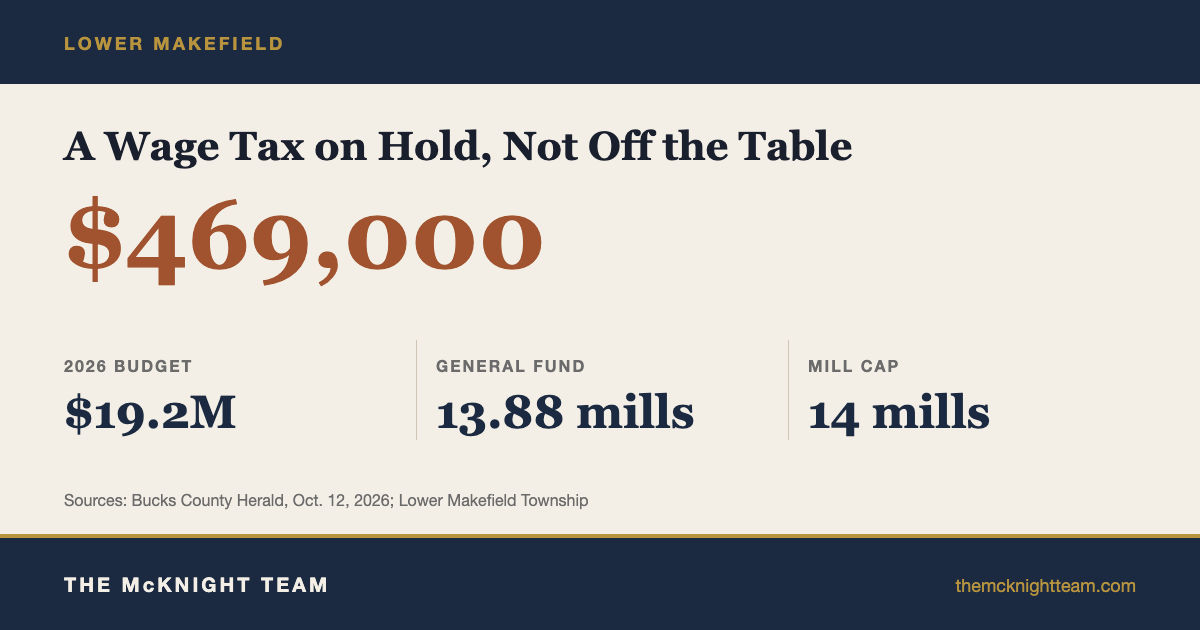
Lower Makefield supervisors have postponed advertising an earned income tax ordinance, the Bucks County Herald reported October 12. The township faces a $469,000 general fund deficit in a $19.2 million budget and sits just under its 14 mill cap.
A Lower Makefield earned income tax is on hold, not off the table. The Herald reported the gap is expected to top $4 million next year, and the board was set to review its 2027 budget on October 21. Our view: a wage tax changes who pays for the township, and owners should understand that before they take a side.
Lower Makefield homes sold for a median of $725,000 from April through September 2026, with a median of 6 days to contract, per Bright MLS data in our Bucks County housing market report. Our read: at that price, a household living on wages would feel an earned income tax more than a millage increase. A household living on retirement income would feel the opposite, because the earned income tax does not reach pensions or Social Security. Buyers will ask which one is coming.
Who Would Pay a Lower Makefield Earned Income Tax
The pressure is the millage cap. A Pennsylvania second class township can levy up to 14 mills for general purposes without court approval. At 13.88 mills, Lower Makefield has 0.12 mills of room left. Going higher would take a judge, and even a court approved rate of 19 mills would not close the projected gap. That is why a Lower Makefield earned income tax keeps coming back to the table.
Today there is no earned income tax in Lower Makefield or the Pennsbury School District, according to the township. People who work in the township pay a $52 local services tax.
An earned income tax is paid by residents on wages and business profits. Pension and Social Security income is not earned income, so most retirees would not pay it. A property tax lands on every owner, working or retired, and landlords pass it through to renters.
The difference matters most at the edges. A household with two working adults and a modest assessment would likely pay more under a wage tax than under a small millage increase. A retired couple on a high assessment would come out ahead, since their income would not be taxed. Renters who work would pay a wage tax directly, where today they pay property tax only through rent.
There is also a timing difference. A millage increase shows up on your township bill once a year. An earned income tax comes out of each paycheck or quarterly estimate, so you feel it month to month instead of in one bill.
Under Pennsylvania’s Local Tax Enabling Act, a township and its school district generally share a combined earned income tax of up to 1%. Next door, Yardley Borough adopted a 1% earned income tax this fall.
If You Own in Lower Makefield
If you are selling, expect buyers to ask about both options. Have your current tax bill ready and know the general fund rate. A clear answer keeps the tax question from becoming a price question. A buyer with two incomes will run the wage tax math. A buyer living on retirement income will run the millage math. Be ready for both conversations. If your home carries a large assessment, a millage increase hits you harder than it hits a smaller house down the street.
If you are buying, run your budget both ways: a higher millage, and a wage tax on your household income. Keep in mind that the school portion of your bill, set by Pennsbury, is still the largest line. If you are comparing Lower Makefield with a nearby township that already has a wage tax, compare the full yearly cost you would pay in each place, not just the millage. For the area, see our Yardley community guide. We are glad to run the math on a specific home.
Thinking about buying or selling in Lower Makefield? Let’s talk.