By Josh McKnight | The McKnight Team
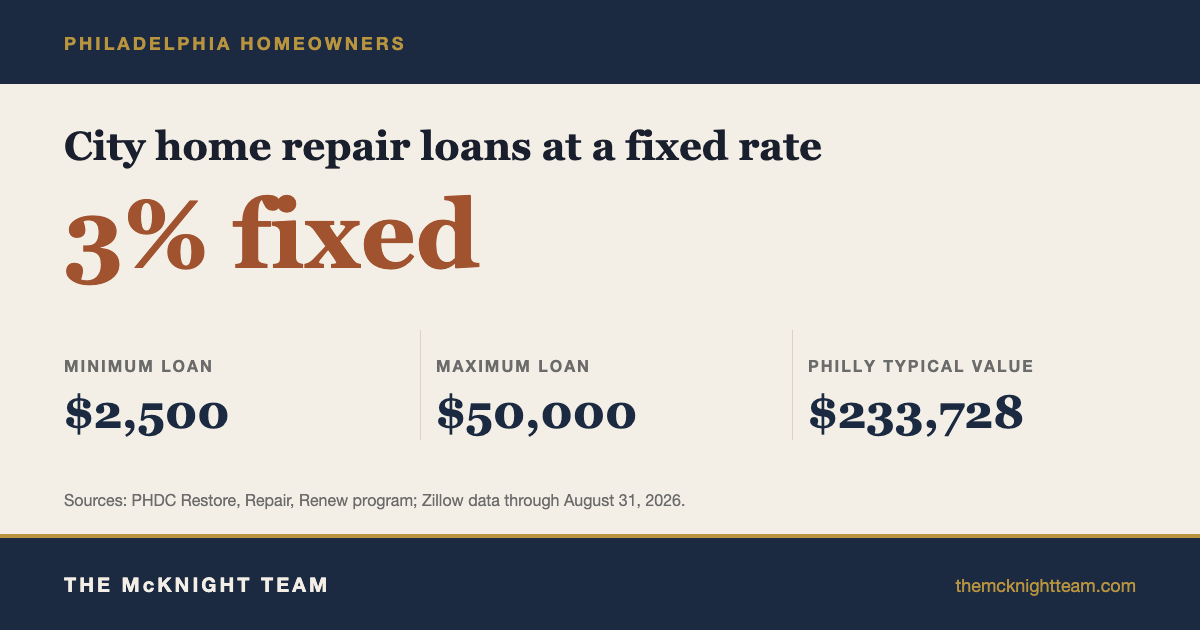
Eligible Philadelphia homeowners can borrow $2,500 to $50,000 at a fixed 3% rate through the Philadelphia Housing Development Corporation’s Restore, Repair, Renew program. The loans cover roofing, siding, sidewalks, driveways, and heating and cooling systems.
Philadelphia home repair loans at that rate are rare, and the timing matters. A failing roof or a dead furnace is the kind of repair that quietly kills a sale or a refinance. This program gives you a way to fix it on a fixed payment instead of a credit card.
What Do Philadelphia Home Repair Loans Through This Program Cover?
PHDC lists five categories: roofing, siding, sidewalks, driveways, and HVAC. Those are the big outside and mechanical items. They are also the items a buyer’s inspector flags first, and the ones a lender’s appraiser notices from the curb.
Notice what is not on the list. Kitchens, baths, and finishes are not the point of this program. It is built to keep the structure and the systems sound, which is exactly where deferred repairs cost owners the most money later.
PHDC sets the eligibility rules, and they can change, so read them on the Restore, Repair, Renew program page before you plan around the loan. Financial counseling is part of the package, and applying does not affect your credit at intake. Use the counseling. A second set of eyes on your budget before you borrow is worth the hour.
Why Does a Fixed 3% Rate Matter?
Fixed means the payment does not move. A roof financed today costs the same every month until it is paid off. Compare that to a credit card or a contractor’s financing offer, and the gap is usually large.
The rate also changes the math on whether to repair at all. A roof spread across a fixed 3% loan is a manageable monthly cost. The same roof paid for in a hurry during a sale is a negotiation you lose, because the buyer knows you have to fix it or give up the money at the table.
There is a quieter benefit too, and it shows up most on older rowhomes where the sidewalk and the front steps take years of wear. A sidewalk or driveway repair can turn into a city violation if it is left alone. Fixing it on your own schedule beats fixing it on someone else’s deadline.
How Does This Fit the Philadelphia Market Right Now?
The typical Philadelphia home value is $233,728, up 0.1% over the past year, and homes go pending in about 24 days, per Zillow data through August 31, 2026. Values are flat. Homes take longer to go under contract than in most of the suburbs around the city.
In a flat market, condition does more of the work. Buyers have time to compare, and they compare on the inspection report. A home with a new roof and a working system reads as the safe choice. A home with a known problem reads as a discount, and the discount is usually bigger than the repair.
That gap is where this program earns its keep. Fixing the problem at 3% before listing takes the biggest negotiating chip off the table before a buyer ever walks in.
Should You Fix It or Sell It As Is?
If you plan to stay, a 3% loan for a failing roof or system is one of the better deals in the city. Fix it, keep the payment, and protect your value for the years you plan to live there. A sound roof and a working furnace also make the house easier to insure and easier to refinance later.
If you plan to sell in the next year, get a pre listing look at your roof and mechanicals first. Some repairs pay for themselves at the closing table and some do not. Our Philadelphia community guide breaks down neighborhood pricing so you can see what your buyers will expect for the money. We will walk through your house with you and tell you which repairs matter.
Thinking about buying or selling in Philadelphia? Let’s talk.