Before you list, you want to know the real cost to sell a house in Pennsylvania. The headline number is your sale price. What you keep is what is left after the costs of selling. Those costs are predictable, and once you see them line by line, you can plan your move with no surprises. Here is the full breakdown for sellers in the Philadelphia suburbs.
What Does It Cost to Sell a House in Pennsylvania?
Most of your selling costs fall into five buckets.
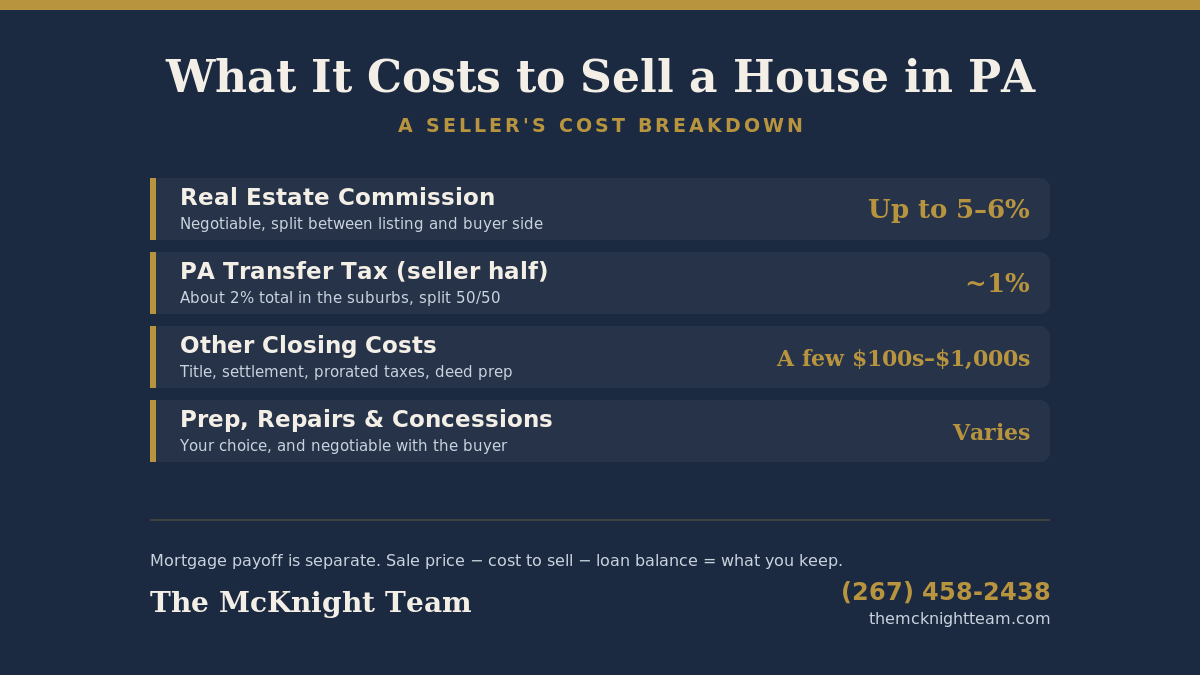
Real estate commission is usually the largest. Pennsylvania transfer tax is next. Then come your other closing costs, any prep or repairs you choose to make, and any concessions you agree to give the buyer. Your mortgage payoff is separate. It is not a cost of selling, but it does come out of your proceeds at closing.
Add the five buckets together and you have your cost to sell. Subtract that and your loan payoff from the sale price, and you have your net proceeds.
Real Estate Commission After the 2024 Rule Changes
Commission is negotiable, and the rules changed in 2024.
Total commission in Pennsylvania still commonly runs up to 5 to 6 percent of the sale price, and it is split between the listing side and the buyer side. On a typical sale the listing agent fee is around 2.5 to 3 percent.
Here is what changed. After the 2024 National Association of Realtors settlement, you as the seller are no longer required to pay the buyer’s agent. Buyer agent pay is also no longer posted on the MLS. Buyers now sign a written agreement with their own agent that spells out that agent’s fee.
In practice, many sellers still offer to cover the buyer’s agent as a concession, because it widens your pool of buyers. Whether you do is now a strategy call, not a default. This is one of the first things to talk through with your listing agent.
Pennsylvania Transfer Tax Explained
Pennsylvania charges a tax when a property changes hands. The state rate is 1 percent of the sale price. Almost every town and school district adds about 1 percent more on top. That brings the total to about 2 percent of the sale price in most Philadelphia suburbs.
By state law, the buyer and seller split the transfer tax 50/50 unless they agree otherwise. So on a typical suburban sale, you as the seller usually pay 1 percent of the price. On a $485,000 home, that is about $4,850.
Two things to know. The split is negotiable, so in a slower market a seller may agree to pay more to close a deal. And the City of Philadelphia is a special case with a much higher rate, about 4.578 percent, so a home inside the city carries a far bigger transfer tax than one in the suburbs. You can read the official rules on the Pennsylvania Department of Revenue site.
Other Closing Costs Sellers Pay
Beyond commission and transfer tax, plan for a few smaller line items.
These include title and settlement fees, the cost to clear any liens or judgments, prorated property taxes up to the closing date, and any deed prep your attorney handles. Together these usually run a few hundred to a couple thousand dollars. If you offer the buyer a closing cost credit to get the deal done, that comes out of your proceeds too.
What a Seller Typically Nets
Here is a simple example on a $485,000 home, near the Montgomery County median.
Start with the $485,000 sale price. Take out commission at 5 percent, which is about $24,250. Take out your half of the transfer tax at 1 percent, about $4,850. Take out roughly $1,500 in other closing costs. That leaves about $454,400 before your mortgage payoff.
Then subtract whatever you still owe on your loan. If you owe $200,000, you walk away with about $254,400. Your numbers will differ, but the math is always the same: sale price, minus the cost to sell, minus your loan balance, equals what you keep. You can compare what homes are selling for in towns like Ambler and Blue Bell through our home search.
How to Estimate Your Own Net Proceeds
A real estimate starts with a real price. We will give you an honest value for your home, lay out every cost line by line, and show you what you would actually net. There is no cost and no pressure to list. If you want to know your true cost to sell a house in Pennsylvania, start with a quick valuation.
Get your free home valuation, or call us at (267) 458-2438.
Frequently Asked Questions: The Cost to Sell a House in Pennsylvania
How much does it cost to sell a house in Pennsylvania?
Plan for roughly 6 to 8 percent of the sale price in total selling costs once you add commission, your half of the transfer tax, and other closing costs. On a $485,000 home that is about $30,000 to $39,000 before your mortgage payoff. The exact figure depends on what you negotiate on commission and concessions.
Who pays the transfer tax in Pennsylvania?
By state law the buyer and seller split it 50/50 unless they agree otherwise. In most Philadelphia suburbs the total transfer tax is about 2 percent, so each side usually pays about 1 percent. The split is negotiable.
Do I still have to pay the buyer’s agent?
No, not since the 2024 rule changes. You are no longer required to pay the buyer’s agent. Many sellers still offer to cover it as a concession to attract more buyers, but that is now your choice to make with your listing agent.
How much is real estate commission in PA?
Total commission commonly runs up to 5 to 6 percent and is negotiable. The listing agent fee is often around 2.5 to 3 percent, with the rest going to the buyer’s side if you choose to offer it.
Can I lower my cost to sell?
Yes. Commission and concessions are negotiable, and smart prep can help your home sell faster and for more, which protects your net. The best first step is an honest pricing and cost review before you list.
Ready to Sell Your Home?
You do not have to guess at the numbers. We will walk you through your full cost to sell and your expected net, with no pressure. Call The McKnight Team at (267) 458-2438 or request your free home valuation.
This is general information, not legal or tax advice. Confirm the exact figures for your sale with your agent, attorney, or tax professional.