By Josh McKnight | The McKnight Team
Jonathan Altshul started work on September 8 as Cheltenham Township’s new manager. He inherits century old facilities, a strained tax base, and residents who already carry the heaviest property tax burden in Montgomery County. His stated goal is to hold the line on further increases.
Cheltenham property taxes are the defining financial fact of owning a home in this township. They are also the reason a 38,000 person community sits below the county typical home value while paying above the county rate.
How the Revenue Gap Actually Works
Two problems compound here. The first is physical. Cheltenham owns aging buildings, including the long closed La Mott and Rowland community centers, and deferred maintenance on century old facilities does not get cheaper by waiting.
The second is structural and harder to fix. An unusually large share of land in the township belongs to tax exempt institutions. That land uses roads, water, and emergency services while contributing nothing to the property tax roll, which means you and every other taxable owner cover the full cost of a township built for everyone.
Altshul’s proposed response is payments in lieu of taxes, an arrangement where exempt landowners voluntarily contribute toward the services they consume. He has framed the approach as pragmatic problem solving rather than a search for silver bullets, which is a realistic way to describe a tool that depends entirely on institutions agreeing to pay something they are not required to pay.
What the Tax Burden Actually Does to Cheltenham Property Taxes
The usual assumption is that high taxes follow high values. In Cheltenham the relationship runs the other way.
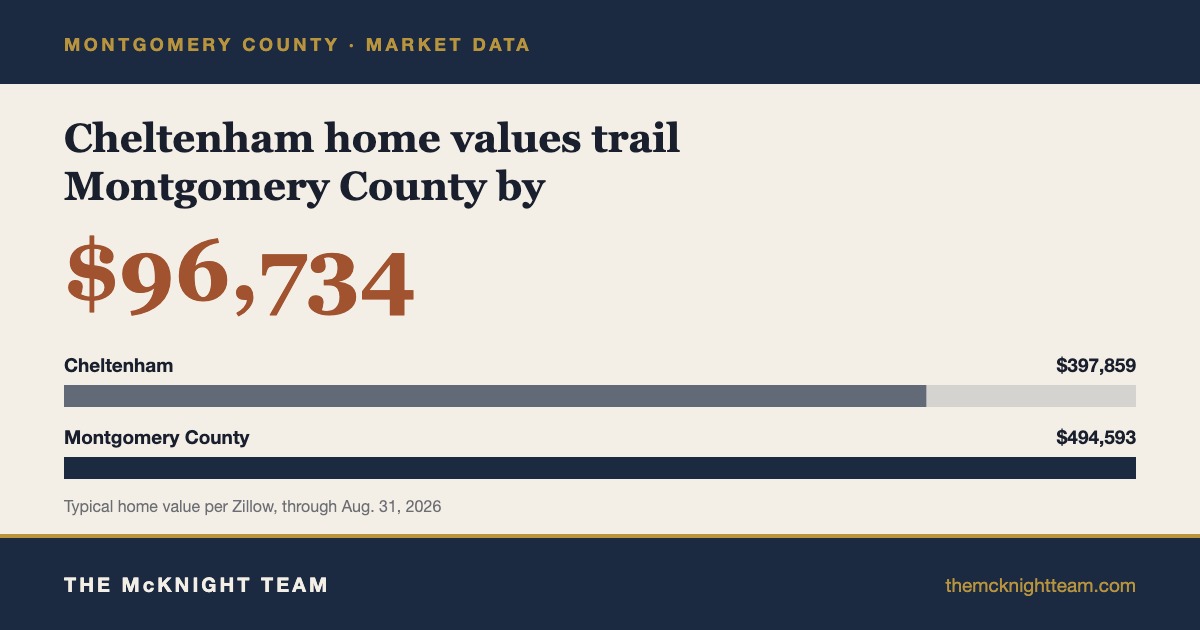
Set that against what the numbers show right now. The typical Cheltenham home value is $397,859, up 1.7% over the past year, with a median list price of $474,665 and just 22 homes on the market, per Zillow data through August 31, 2026. Montgomery County as a whole sits at $494,593.
That is a gap of $96,734 below the county typical value. Cheltenham owners pay the county’s heaviest property tax burden on homes worth less than the county average. The 1.7% annual gain, against a county running well ahead of it, is what that combination produces in your equity over time.
Why Tax Burden Shows Up in Your Sale Price
Buyers do not shop for homes. Buyers shop for monthly payments. That is true of whoever eventually looks at your house. A higher millage rate means a larger escrow line, and a larger escrow line means a smaller loan approval at the same income.
Run the logic to its end. If two comparable houses in two adjacent townships carry a meaningful difference in annual tax, the higher taxed house must price lower to produce the same monthly cost for the same buyer. The market does that math automatically, every time, without anyone deciding to. Capitalized tax burden is not a theory. It is the $96,734.
This is also why holding the line matters more than cutting. Altshul is not promising relief. He is promising stability, and stability is what allows values to catch up rather than continue drifting. A township that stops raising millage while the county keeps appreciating closes the gap without ever cutting a rate.
Both things can be true: Cheltenham offers real housing value for what you pay, and the tax line is a genuine constraint on resale. Owners who understand the second fact negotiate better on the first, and you should be one of them. If you own here and have never compared your assessment against recent neighborhood sales, that is an afternoon well spent, and worth mentioning to a neighbor.
What This Means for You
If you own in Cheltenham, pull your current assessment and compare it against what similar homes nearby have actually sold for in the past year. An assessment set when values were different is an appealable assessment, and with only 22 homes on the market your comparable set is small enough to review carefully. If you are buying here, get the real annual tax figure for the specific parcel before you write, not the township average.
The value proposition in Cheltenham is real, and so is the arithmetic working against quick appreciation. Both show up clearly in our Cheltenham community guide, which covers how the neighborhoods price against the rest of the county.
Thinking about buying or selling in Cheltenham? Let’s talk.
Frequently Asked Questions About Cheltenham Property Taxes
Why are Cheltenham property taxes so high?
The township carries aging infrastructure, including century old facilities, alongside an unusually large share of land owned by tax exempt institutions. Fewer taxable properties cover the full cost of services, which pushes the burden onto remaining owners.
Do high property taxes lower Cheltenham home values?
They contribute. The typical Cheltenham home value is $397,859 against a Montgomery County figure of $494,593, a gap of $96,734. Buyers price on monthly cost, so a higher tax line reduces what the same buyer can pay.
What are payments in lieu of taxes?
They are voluntary contributions from tax exempt landowners toward the municipal services they use. Township manager Jonathan Altshul is considering encouraging them as a way to close Cheltenham’s revenue gap without raising rates on residents.
Can I appeal my Cheltenham assessment?
Montgomery County allows property owners to file assessment appeals on an annual schedule. Comparing your assessed value against recent nearby sales is the first step, and with 22 homes currently listed the comparable set is manageable.