By Josh McKnight | The McKnight Team
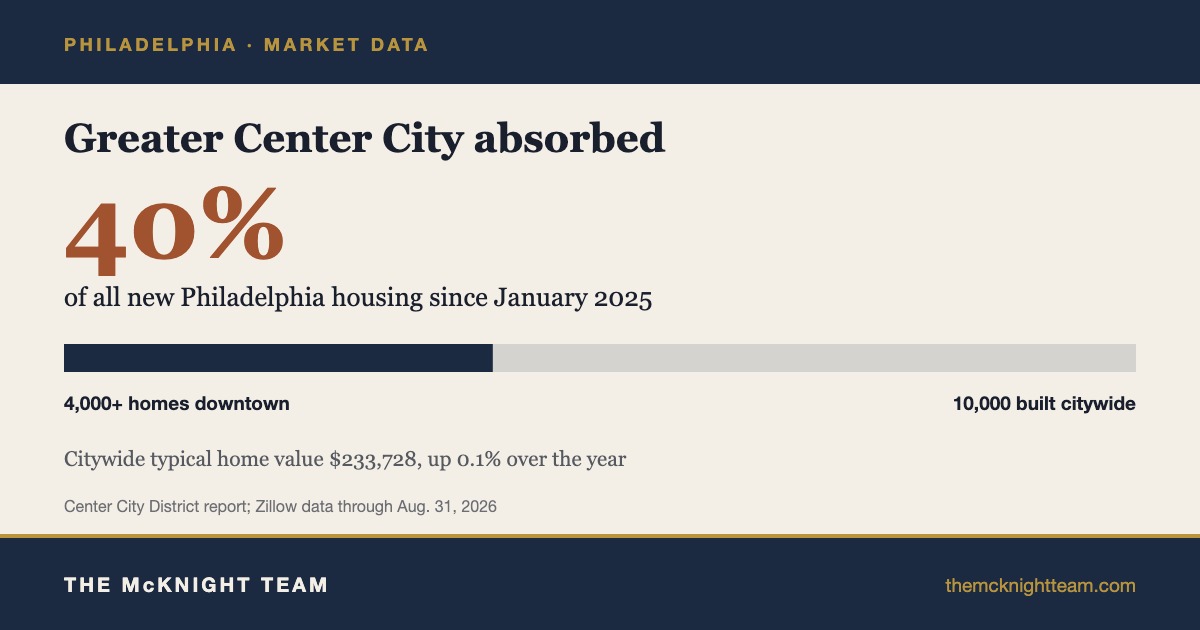
Greater Center City accounted for more than 40 percent of the roughly 10,000 homes built across Philadelphia since the start of 2025, according to a new Center City District report. More than 4,000 homes were completed in the area from Girard Avenue to Tasker Street, river to river, during the 18 months ending June 30.
The Philadelphia real estate market has not seen construction concentrate this tightly in a generation. Going back to January 2024, the broader downtown has added about 7,800 units, which is 26 percent of Mayor Cherelle Parker’s goal of 30,000 homes through the city’s HOME initiative.
How the Construction Boom Actually Breaks Down
The geography is narrow and the output is not. Girard Avenue to Tasker Street, river to river, is a small fraction of a 134 square mile city, and it produced four out of every ten new homes built citywide over an 18 month stretch.
The unit mix is the qualifier. Center City District officials note that much of the new downtown housing is studios and one bedroom apartments rather than family sized units or traditional affordable housing. That shapes who the supply actually serves: a household of one or two, renting, with no plan to need a second bedroom soon.
Against the HOME initiative target, 7,800 units since January 2024 represents 26 percent of 30,000. Solid progress on a hard number, delivered overwhelmingly in one part of the city and overwhelmingly in one unit type. If you are shopping downtown, that is the inventory you are actually shopping.
What the Building Boom Actually Does to the Philadelphia Real Estate Market
New supply is supposed to moderate prices. Look at whether it did where you live.
Set that against what the numbers show right now. The typical Philadelphia home value is $233,728, up 0.1% over the past year, with homes going to pending in about 24 days and 5,910 properties on the market, per Zillow data through August 31, 2026.
One tenth of one percent. That is the citywide value change while 10,000 new homes came online. Supply did exactly what supply does. Anyone who told you building more housing has no effect on prices has an explanation to offer.
Why This Matters to Buyers Outside the City
A 24 day pending timeline in Philadelphia sits against six to eleven days across most of Bucks, Montgomery, and Delaware counties. That difference is the story you should be reading.
The mechanism is straightforward. Downtown added 4,000 mostly small rental units aimed at exactly the households that would otherwise be the entry level buyer pool. Those households now have an option that did not exist three years ago, and if you are selling an entry level suburban home, some of your buyers are choosing it. Meanwhile the suburbs added very little, and their values kept climbing while the city’s flattened to 0.1 percent.
This is also a caution against reading a single citywide number as the whole picture. A 0.1 percent change across Philadelphia averages neighborhoods moving in genuinely different directions, and 5,910 active listings is a market with real variation inside it. The average conceals more than it reveals, and it almost certainly conceals your block.
Both things can be true: Philadelphia’s building boom is working as intended, and a flat citywide value is not good news for every owner in it. If you have been telling friends the city is a tough place to build equity right now, the 0.1 percent figure is the number to hand them, along with the reason behind it.
What This Means for You
If you own in Philadelphia, a flat year citywide means your individual neighborhood is doing something more specific than the average suggests, and it is worth getting an actual comparable analysis rather than a headline. If you are weighing city against suburbs, notice that you are trading a 24 day market with 5,910 listings for suburban markets clearing in about a week with far less to choose from. More time and more options, against faster appreciation.
That tradeoff is the real decision most buyers in this region are making right now, and it looks different at every price point. Our Philadelphia community guide covers how the neighborhoods price against each other and against the suburban markets just over the county line.
Thinking about buying or selling in Philadelphia? Let’s talk.